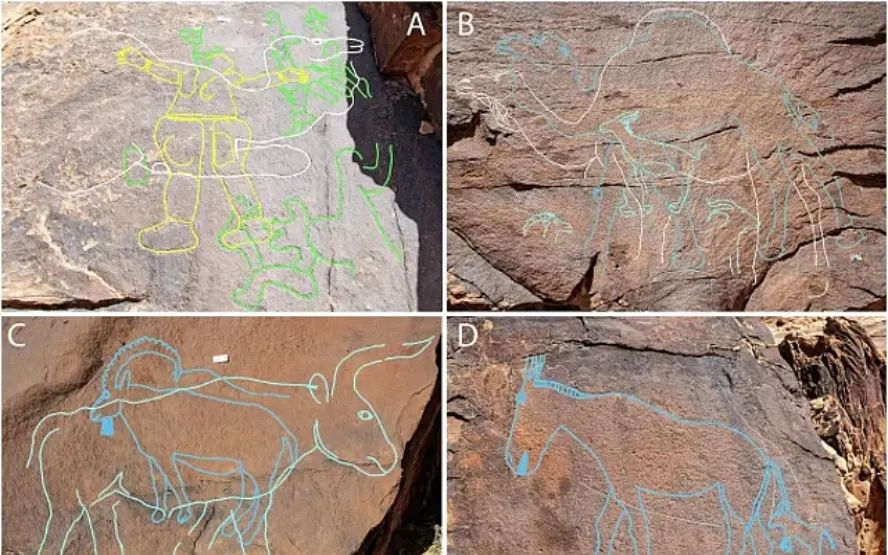
Researchers suggest that these artworks were created during a humid climatic phase between 13,000 and 16,000 years ago, a period that allowed human populations to thrive in regions that are now arid.
Saudi Arabia’s Heritage Commission has announced the discovery of exceptional life-size rock art engravings in the Al Nafud Desert, dating back between 11,400 and 12,800 years. This discovery represents the earliest scientifically dated phase of rock art in the Kingdom.
The engravings were uncovered south of the Al Nafud Al Kabir desert in the Hail Region under the “Green Arabia Project,” in collaboration with an international team of researchers from local and global universities and research centres. The study documented 176 carvings, including 130 life-size depictions of camels, ibexes, horses, gazelles, and the now-extinct aurochs. Some images span up to three meters and are located in elevated, difficult-to-access areas, highlighting the remarkable skill and effort of the ancient artists.
Researchers suggest that these artworks were created during a humid climatic phase between 13,000 and 16,000 years ago, a period that allowed human populations to thrive in regions that are now arid. The discovery sheds light on the development of rock art, prehistoric lifestyles, and the cultural and economic links connecting the northern Arabian Peninsula with neighbouring regions.