65-Year-Old Woman Plays Clarinet During Brain Surgery for Parkinson’s
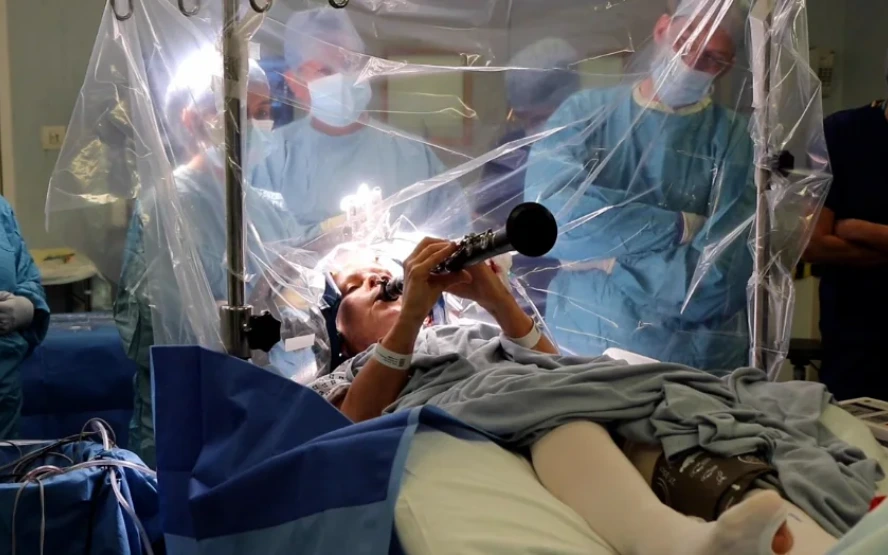
In an extraordinary procedure, a 65-year-old woman underwent awake brain surgery and played her clarinet while electrodes were being implanted to treat her Parkinson’s disease.
In an extraordinary procedure, a 65-year-old woman underwent awake brain surgery and played her clarinet while electrodes were being implanted to treat her Parkinson’s disease.
The patient, a retired speech and language therapist, had been diagnosed with Parkinson’s in 2014 and had gradually lost the ability to walk, swim, dance and play her instrument. With the surgery, the medical team aimed to restore movement by using deep brain stimulation (DBS).
The Procedure
Performed at a major London hospital, the patient had electrodes placed in targeted areas of the brain responsible for motor control. During the operation, which lasted about four hours, she remained awake while surgeons made tiny burr-holes in her skull. A local anesthetic numbed the scalp and skull; the brain itself was pain-free. Once the electrodes were activated, surgeons observed immediate improvement: her fingers moved more smoothly, allowing her to play the clarinet with ease for the first time in years.
This case illustrates the remarkable precision and monitoring made possible by awake brain surgery combined with DBS. By having the patient play her instrument during the procedure, surgeons could receive real-time feedback on motor function and fine-tune stimulation for optimal results.
Outlook
While not a cure, DBS in this context offers significant improvement in quality of life for patients whose medication is no longer sufficiently controlling symptoms. Post-surgery, the woman is already experiencing better mobility and hopes to return to musical performance and dancing.