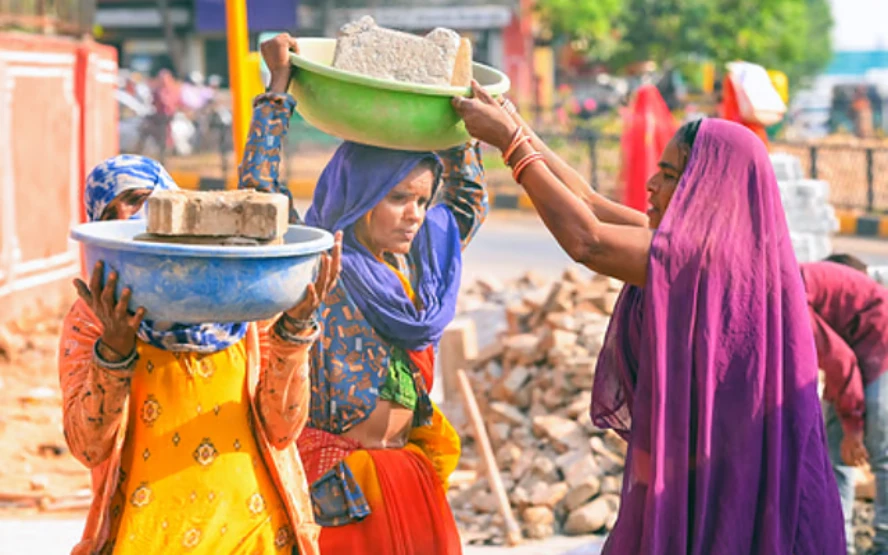
India rural employment law 2025 ushers in a redesigned system as the Viksit Bharat – Guarantee for Rozgar and Ajeevika Mission (Gramin), or VB‑G RAM G Act, replaces MGNREGA with a more infrastructure-driven, digitally governed framework. The new law raises the job guarantee from 100 to 125 days per rural household while linking public works to long-term plans under the Viksit Bharat 2047 vision.
What the new VB‑G RAM G Act does
The Act increases guaranteed wage employment to 125 days per rural household for adults willing to do unskilled manual work and shifts focus from scattered projects to four priority verticals: water security, core rural infrastructure, livelihood-related assets and climate-resilient works. Assets created will be mapped onto a National Rural Infrastructure Stack and connected with platforms like PM Gati-Shakti to enable unified planning and geospatial monitoring.
A key feature is the requirement for Viksit Gram Panchayat Plans—digitally integrated village plans that align local projects with national systems. Officials say this moves the programme toward a “modern, infrastructure-focused, digitally governed” model that aims to deliver both income security and durable productivity gains in agriculture and rural livelihoods.
Why MGNREGA is being replaced
The government argues that rural India has changed significantly since MGNREGA’s launch in 2005, citing sharp declines in poverty, better financial access and more diversified incomes. They contend that the old demand-driven, open-ended model no longer fits current conditions and has faced recurring problems like ghost works, machine use in labour-intensive projects, fund misuse and misappropriation—reported at Rs 193.67 crore in 2024–25 alone.
VB‑G RAM G shifts to a normative funding model with a 60:40 Centre–State sharing ratio (90:10 for North-Eastern and Himalayan states and full central funding for some Union Territories) while retaining the legal guarantee and mandatory unemployment allowance if work is unavailable. The aim is to balance fiscal predictability with assured employment, using better forecasting and clearer Centre–State responsibility.
Digital governance, transparency and oversight
The new law embeds technology deeply into implementation, mandating AI-based fraud detection, GPS and mobile monitoring, real-time dashboards, weekly public disclosures and twice-yearly social audits for every Gram Panchayat. Biometric and Aadhaar-based verification for wage payments, already near universal, will continue, with wages routed through electronic transfers to reduce leakages.
Central and state steering committees will oversee implementation, helping track progress, flag anomalies and adjust priorities. Officials say this digital-first approach is designed to cut misappropriation, tighten accountability and ensure that money spent generates visible, high-quality assets.
Impact on water, farming and rural livelihoods
Priority for water-related works is expected to strengthen irrigation, groundwater recharge and resilience against droughts, building on programmes like Mission Amrit Sarovar which has already restored or created tens of thousands of water bodies. Core infrastructure—such as rural roads, storage facilities and market-linked assets—should improve connectivity and help farmers and workers diversify income sources.
The Act also recognises the need to synchronise with the farming calendar by allowing states to pause public works for up to 60 days during peak sowing and harvest. This is meant to keep labour available for agriculture, stabilise production costs and let workers shift to higher-paying seasonal farm jobs when those opportunities arise.
Balancing workers’, farmers’ and states’ interests
For labourers, the combination of 125 guaranteed days, digital payments and clear unemployment allowance provisions is intended to improve both earnings and predictability of work. For farmers, the flexibility around peak seasons aims to reduce labour shortages and wage spikes. For states, the co-funding model and national digital tools seek to provide structure while still allowing local priority-setting through Gram Panchayat Plans.
Taken together, the VB‑G RAM G Act positions rural employment not just as a safety net, but as a driver of long-term economic transformation—tying wage work directly to infrastructure, water security, climate resilience and productivity as India advances toward its Viksit Bharat 2047 goals.
Gulf Repost breaks down major policy shifts and economic reforms across India and the wider region in clear, practical language. From landmark employment laws and rural development missions to financial inclusion and infrastructure pushes, Gulf Repost helps readers understand how big-picture decisions affect livelihoods, investment, and long-term growth trajectories.