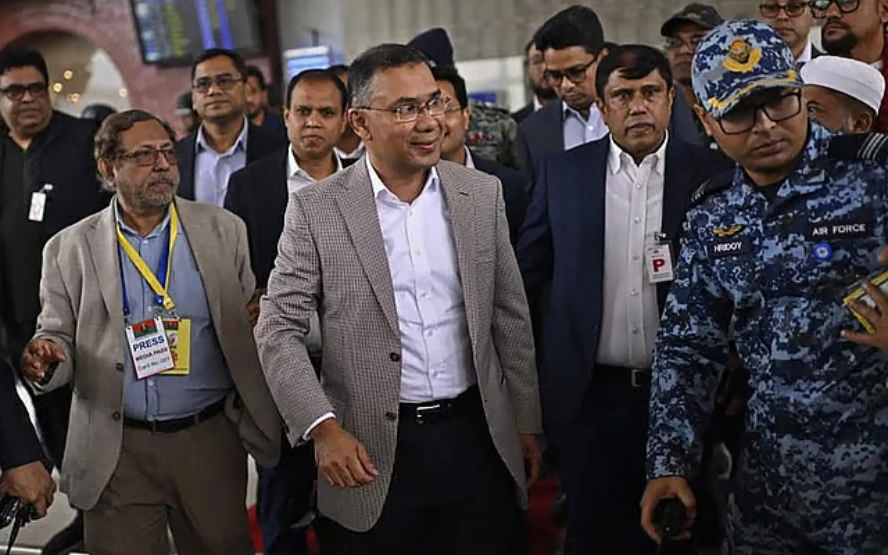
Prime minister hopeful Tarique Rahman arrives in Bangladesh to a massive welcome in Dhaka, returning from 17 years of self-imposed exile in London to lead the Bangladesh Nationalist Party (BNP) into the February 12 general election.
Prime minister hopeful Tarique Rahman arrives in Bangladesh: Emotional homecoming
Prime minister hopeful Tarique Rahman arrives in Bangladesh with his wife and daughter, greeted by huge crowds, party banners and patriotic songs as he lands at Dhaka airport.
Visibly emotional, the 60-year-old BNP acting chairman removed his shoes, stepped onto the grass, lifted a handful of soil in tribute and then departed in a tight-security convoy, with supporters calling him the only leader who can “fix” the country’s “dire situation.”
Political stakes as BNP’s frontrunner returns
Rahman, son of former prime minister Khaleda Zia, left for London in 2008 claiming political persecution but will now front the BNP’s campaign in the first election since ex-premier Sheikh Hasina was ousted by a student-led uprising.
With the Awami League barred from contesting and Rahman cleared of a life sentence linked to a 2004 grenade attack, the BNP is widely seen as a frontrunner, and he is expected to be proposed as prime minister if the party wins a majority.
Unrest, anti-India anger and shifting alliances
His return follows unrest triggered by the killing of student leader Sharif Osman Hadi, an outspoken India critic, whose death sparked violent protests, attacks on media seen as pro-India and stone-pelting at the Indian High Commission in Chattogram.
India has suspended visa services in the city, while ties with Dhaka have soured as India weighs Bangladesh’s request to extradite Hasina, sentenced to death in absentia over the crackdown on last year’s uprising.
Khaleda Zia’s health and calls for stability
Khaleda Zia, 80, remains in intensive care in a Dhaka hospital after vowing in November to campaign despite years of ill health and imprisonment.
BNP figures like former lawmaker Jahan Panna describe Rahman as a “symbol of hope” who can end the “cycle of anarchy,” even as the interim government under Nobel laureate Muhammad Yunus oversees the transition to elections.
Gulf Repost follows pivotal moments like when a prime minister hopeful Tarique Rahman arrives in Bangladesh, unpacking what leadership shifts, uprisings and regional tensions mean for South Asia and the wider Gulf audience.
From exile returns and election campaigns to India–Bangladesh relations and governance transitions, Gulf Repost delivers clear, contextual coverage for readers across the UAE and beyond