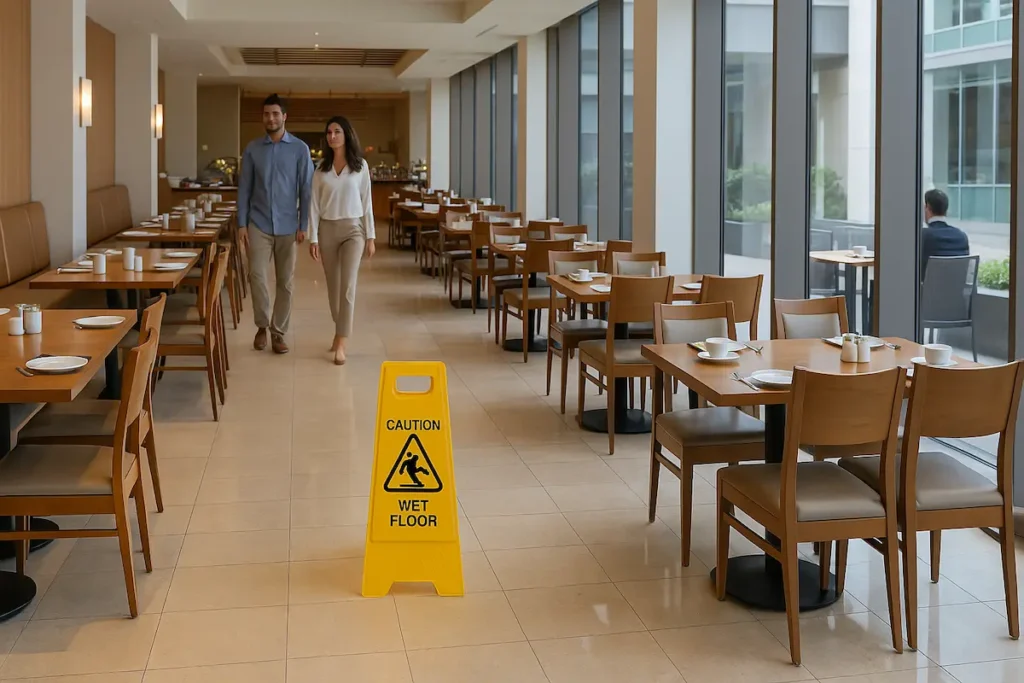
Dubai slip and fall lawsuit rulings in the UAE continue to underline the importance of clear evidence, accountability, and timely reporting, as a recent civil court judgment in Dubai reaffirmed strict standards for establishing liability in personal injury claims. The court dismissed a Dh5 million compensation lawsuit filed by an African tourist who alleged that she suffered significant injuries after slipping on a wet floor inside a hotel restaurant.
The case, first reported by Emarat Al Youm, involved allegations that the visitor fell during a routine breakfast outing with her husband. According to her testimony, a “pool of water” on the restaurant floor caused her to lose balance, drop her plate, and collapse near guests seated in the dining area. Witnesses described hearing a sharp scream moments before she was found on the ground.
The plaintiff accused the hotel of negligence, arguing that the absence of warning signs for a wet surface directly contributed to her fall. She submitted medical records claiming the incident left her with severe injuries, long-term pain, and emotional distress.
Court Finds No Proof Linking Injuries to Hotel Negligence
In her lawsuit, the woman asserted that the fall drastically changed her quality of life. Court documents revealed she underwent physiotherapy, MRI scans, and multiple medical consultations. A neurosurgeon later recommended what she described as a complex surgical intervention. She also reported needing controlled painkillers, mobility support equipment, and a wheelchair.
However, the hotel’s legal team denied any responsibility. In their detailed response, they pointed out that the plaintiff had not filed a police report, medical incident report, or any form of official documentation confirming the slip occurred inside the property. This absence of formal evidence, they argued, made it impossible to determine whether the incident happened as claimed.
The defense further highlighted that the medical reports presented by the plaintiff did not establish a causal link between her injuries and any fall on the hotel premises. Without direct evidence connecting the alleged unsafe condition to her physical injuries, the lawyers maintained that civil liability could not be imposed on the establishment.
Judge Applies UAE Tort Law Standards to Dubai Slip and Fall Lawsuit
The case moved through Dubai’s Dispute Management Office before reaching trial in civil court. After thoroughly reviewing the submissions, the judge emphasized long-standing principles of tort law in the UAE:
-
A proven fault must exist.
-
Actual damage must be demonstrated.
-
A direct causal relationship must link the fault to the damage.
The judge noted that the burden of proof lies entirely with the claimant, and courts are not obligated to guide individuals on how to present their evidence or construct their legal arguments.
In this case, the plaintiff’s file lacked critical documentation such as hotel incident logs, eyewitness statements, or CCTV evidence. The documents she submitted—mostly medical notes and personal communications—were deemed insufficient to establish hotel negligence. As a result, the court dismissed the case and ordered her to pay court fees, administrative costs, and the hotel’s legal expenses.
UAE Legal Experts: Ruling Reinforces Importance of Immediate Reporting
Legal analysts say this ruling highlights a vital message for residents, expatriates, and tourists in the UAE: claims involving slips, falls, or injuries inside hotels and restaurants must be supported by official, timely, and verifiable reports. Without such documentation, establishing a chain of responsibility becomes nearly impossible.
The verdict also aligns with the UAE’s broader commitment to maintaining high safety standards in the hospitality industry. Hotels and resorts across Dubai and the wider UAE are required to follow strict protocols, including clear signage for hazards, maintenance logs, and rapid incident reporting procedures.
For businesses, this ruling reinforces the need to maintain thorough internal documentation and ensure proper safety warnings—especially in areas prone to spills or heavy foot traffic. For guests, it serves as an important reminder:
-
Notify hotel staff immediately.
-
Request an official incident report.
-
Capture photos or videos.
-
Obtain eyewitness information.
-
Seek timely medical assessment.
These steps significantly strengthen any future claim involving negligence or injury.
With Dubai’s hospitality sector continuing to expand, such legal rulings help clarify expectations on both sides and reinforce the UAE’s emphasis on fairness, transparency, and responsibility within public spaces.