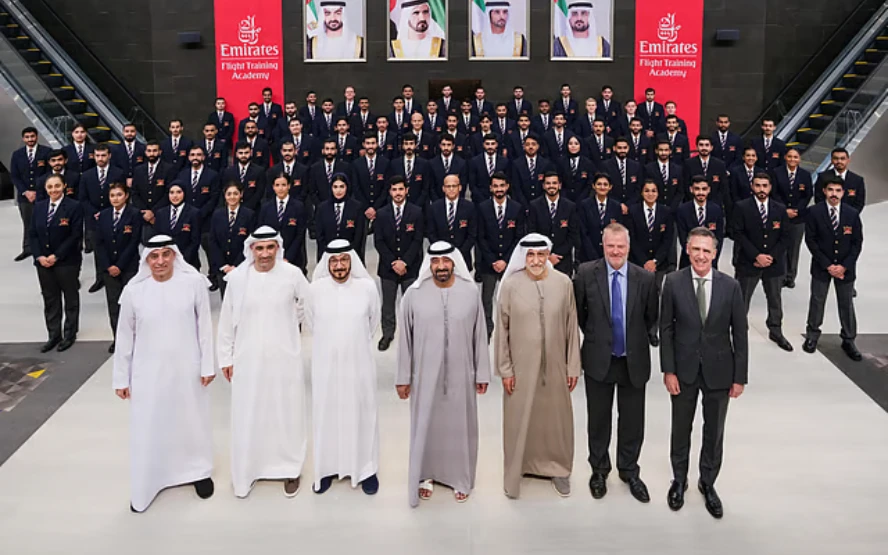
Emirates 5000 pilot vacancies plan spans eight years, as revealed by Co-Deputy President and Chief Operating Officer Adel Ahmed Al Redha, to fuel the airline’s expansion amid surging travel demand and new aircraft deliveries like 777X and A350 orders. The target addresses regional forecasts needing 10,300 pilots by 2030, with Emirates drawing from multiple sources including its own academy, direct-entry experienced pilots and international talent.
Multi-channel recruitment strategy
Al Redha emphasised a broad approach since no single academy can meet the scale: “multiple sources funding that number, whether from an academy, whether it is from direct entry, or from international.” The Emirates Flight Training Academy (EFTA) provides a key pipeline, having graduated over 300 pilots now flying for the airline, with 77 cadets earning wings at the sixth ceremony—instilling Emirates-specific mindset from day one.
The wider Emirates Group strategy, announced in July 2025, aims to hire 17,300 people across 350 roles this financial year, supported by over 2,100 global recruitment events in 150 cities that drew 3.7 million applications last year. Since 2022, more than 41,000 professionals have joined, growing the workforce to 121,000.
Who can apply: Cadet pilots and experienced hires
Cadet Pilot Programme (via EFTA): Open to motivated individuals aged 17.5–29 with high school completion (or equivalent), strong English proficiency and no prior flying experience required. Successful applicants undergo 18–24 months of training at EFTA in Dubai, covering ground school, simulators and flight hours on single/multi-engine aircraft. Graduates like 21-year-old Sebastian Piroddi-Botha (praising world-class instructors) and 22-year-old Giada Macario (from Italian Air Force background) transition to Emirates type-rating and line training.
Direct Entry Pilots: Experienced captains and first officers from other airlines, with current type ratings (e.g., Boeing 777, A380, A350), minimum flight hours (typically 4,000+ total time, 1,000+ on type) and valid ATPL. Priority for those with Middle East operations familiarity.
Applications via emiratesgroupcareers.com; events and walk-ins hosted globally. Perks include profit-sharing, medical/life insurance, annual leave tickets for family and discounts.
Regional pilot shortage context
Airbus forecasts 60,000+ pilots needed in the Middle East by 2034. Al Redha noted rising air travel demand: “We are seeing the demand increasing day by day. There will be a need for more pilots.” Emirates’ push aligns with Dubai’s aviation hub ambitions.
Gulf Repost spotlights career opportunities and industry expansions across UAE aviation and beyond, from pilot hiring drives to airline growth and talent pipelines. By detailing qualifications, processes and perks, Gulf Repost helps professionals navigate high-demand sectors shaping the region’s economic future.