

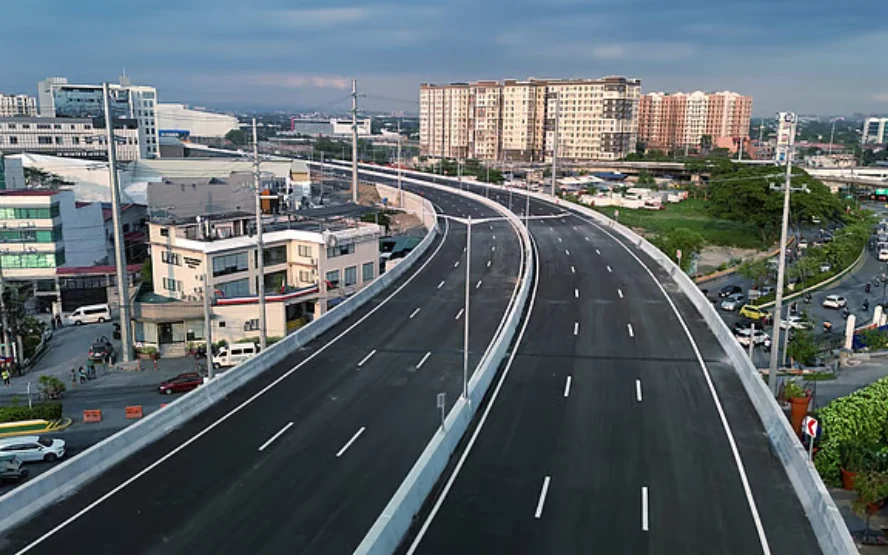
The Cavitex-C5 Link Expressway opening marks a major milestone in Metro Manila’s infrastructure development. On March 30, 2026, President Ferdinand Marcos Jr. officially inaugurated Segment 3B of the expressway — a critical 2-kilometer stretch connecting Parañaque to Taguig, designed to alleviate traffic congestion and improve commuter mobility in one of the country’s most traffic-challenged urban areas.
Cavitex-C5 Link Expressway Opening: Immediate Relief With Toll-Free Access Until April 30
In a strategic move timed with the Holy Week travel surge, President Marcos declared the new expressway segment toll-free for the entire month of April. This initiative aims to ease the travel burden on thousands of motorists heading out of Metro Manila during one of the busiest travel seasons of the year.
Previously, trips between the coastal Sucat area and Taguig took upwards of 90 minutes, a frustrating delay for daily commuters and freight operators alike. With the Cavitex-C5 Link Expressway opening, travel time is expected to drop dramatically to just 15 minutes, unlocking efficiency and productivity gains.
Traffic Decongestion and Economic Impact of the New Expressway
The expressway is projected to serve around 36,000 vehicles daily, acting as a vital pressure valve to relieve congestion on southern Metro Manila’s key thoroughfares. It improves access to bustling business districts such as Bonifacio Global City (BGC) and residential zones, facilitating smoother movement and reducing travel stress.
This new infrastructure comes at a time when rising global fuel prices, driven by ongoing Middle East tensions, have strained household budgets and transport costs. By reducing travel times and associated fuel consumption, the toll-free expressway supports economic resilience and sustainability.
Infrastructure as a Catalyst for Economic Stability: Uplift Strategy
The Cavitex-C5 Link Expressway opening aligns with the Philippine government’s “Uplift” strategy — a comprehensive approach to cushioning the economy through enhanced infrastructure, transport efficiency, and improved mobility.
Faster, more reliable roads mean lower operating costs for logistics providers and commuters, supporting business continuity and everyday life amid global uncertainties.
Strategic Significance of the Cavitex-C5 Link Expressway
More than just a new road, the expressway is a strategic connector:
- It links the coastal Cavite Expressway (CAVITEX) to inland business hubs in Taguig and Metro Manila.
- It enhances access to Ninoy Aquino International Airport, facilitating smoother passenger and cargo flows.
- It supports freight movement between Cavite, Parañaque, and Taguig, crucial for regional commerce.
- It complements ongoing expansions in Metro Manila’s southern growth corridors, responding to urban sprawl and increasing demand.
This short but critical 2-km link bridges a long-standing gap, enabling motorists to bypass congested local roads and dramatically reduce travel times.
The Bigger Picture: Infrastructure Efficiency as Progress
The Cavitex-C5 Link Expressway opening reflects a broader shift in Philippine infrastructure development priorities. Instead of focusing solely on mega-projects, targeted, high-impact connectors are prioritized for immediate and tangible benefits.
As fuel prices remain volatile and global economic conditions uncertain, efficient infrastructure becomes a cornerstone of sustainable growth and improved quality of life.
For thousands of drivers this Holy Week, the benefits will be felt in saved hours rather than policy announcements — a real-world testament to government commitment.
About Gulf Repost
Gulf Repost is a premier news and information platform dedicated to offering timely, accurate, and comprehensive coverage across the Gulf region and the Middle East. We specialize in economic developments, urban infrastructure, social policies, and cultural narratives, providing readers with nuanced insights and trustworthy reporting. Our mission is to empower individuals, global and policymakers with the critical knowledge needed to navigate the region’s fast-changing landscapes. From infrastructure milestones like the Cavitex-C5 Link Expressway opening to broader urban mobility trends, Gulf Repost remains the essential source for understanding the dynamic forces shaping the Gulf and neighboring regions today.
Frequently Asked Questions
How much is the toll on the Cavitex C5 link?
The CAVITEX-C5 Link has significantly expanded since its 2019 debut, with the final Segment 3B officially opening today, March 30, 2026. This new stretch connects Parañaque to Taguig in just 15 minutes and will be toll-free for the entire month of April 2026 to support Holy Week travelers. Standard updated rates for the expressway now stand at ₱35 for Class 1, ₱69 for Class 2, and ₱104 for Class 3 vehicles.
Is C5 an expressway?
The CAVITEX-C5 Link is a 7.7-kilometer urban expressway starting at C.P. Garcia Avenue in Taguig. Featuring a flyover that crosses the SLEX-Skyway, this project seamlessly connects the C5 corridor to the original CAVITEX at the Manila coast, significantly reducing travel time between the eastern and western portions of Metro Manila.
What RFID is used in Cavitex C5 link?
Easytrip RFID is the dedicated electronic payment system for all MPTC tollways, including NLEX, CAVITEX, SCTEX, NLEX Connector, and CALAX. For seamless travel across the Philippines, these tags are also interoperable with Autosweep RFID toll booths, allowing a single sticker to cover both major expressway networks.
Who is the owner of CAVITEX?
CAVITEX is operated and maintained by the Public Estates Authority Tollway Corporation (PEATC), a government-owned and controlled corporation (GOCC). It functions as a subsidiary of the Public Estates Authority (PEA) under the Office of the President, managing the expressway through a strategic joint venture with the Cavite Infrastructure Corporation (CIC).
Is CAVITEX under Easytrip?
Easytrip Services Corporation, a Metro Pacific Tollways (MPTC) subsidiary, is the exclusive electronic toll provider for NLEX, SCTEX, CAVITEX, the C5 Link, and CALAX. It integrates and manages the RFID systems across these key northern and southern Luzon expressways to ensure seamless, cashless travel.


