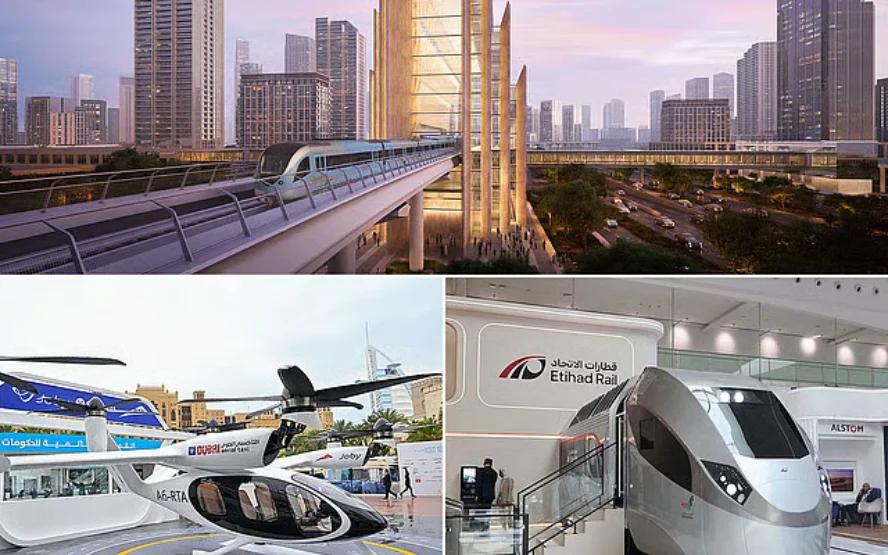
UAE traffic 2026 transport plans signal a major shift toward faster, smarter, and more sustainable mobility, with Dubai at the centre of a Dh170 billion federal investment in roads, rail, flying taxis, metro expansion, and AI-powered systems. Together, these nine projects are set to ease congestion, cut travel times, and move the city closer to its ‘20-Minute City’ vision by 2030.
1. Dh170 billion national road network upgrade
A nationwide package of road and transport projects will significantly benefit Dubai motorists by 2030, with a focus on easing congestion and boosting connectivity between emirates:
-
Emirates Road: Expanded to 10 lanes across its full length, increasing capacity by 65% and cutting journey times by 45%.
-
Sheikh Mohammed bin Zayed Road: Also widened to 10 lanes, enhancing capacity by 45%.
-
Etihad Road: Six new lanes (three each way), taking the total to 12 lanes and boosting capacity by 60%.
These upgrades will make long-distance daily commutes smoother and much faster for inter-emirate travellers.
2. Dubai Loop: Elon Musk’s underground transport network
Dubai is set to host the first Middle East project from The Boring Company, with the Dubai Loop expected to debut in Q2 2026.
-
High-speed underground network linking key districts.
-
Weather-proof, congestion-free “wormhole-like travel,” as Elon Musk describes it.
-
Tunnels designed to be structurally safe, even in seismic events—“like being in a submarine during a storm.”
If fully realised, the Dubai Loop could redefine intra-city travel with fast, point-to-point underground journeys.
3. Flying taxis launching by 2026
By 2026, Dubai aims to become the first city in the world to operate a fully commercial air taxi service integrated into its transport network—not just a pilot scheme.
-
Operated by Joby Aviation under an exclusive six-year agreement with RTA.
-
Electric eVTOL aircraft: four passengers + one pilot.
-
Range over 200 km, speeds above 300 km/h.
-
Dubai–Abu Dhabi or Dubai–Fujairah flights in under 30 minutes.
-
First vertiport already under construction at Dubai International Airport (behind the Emirates building), with more vertiports planned.
This will create an entirely new premium, high-speed mobility layer above the city.
4. Etihad Rail passenger services by 2026
The Etihad Rail passenger network is expected to begin operations by 2026, transforming inter-emirate travel:
-
Capacity: up to 400 passengers per train, multiple daily trips.
-
Indicative travel times:
-
Abu Dhabi–Dubai: 57 minutes
-
Abu Dhabi–Fujairah: 105 minutes
-
Abu Dhabi–Ruwais: 70 minutes
-
-
Planned high-speed link: Abu Dhabi–Dubai at up to 350 km/h, cutting travel time to around 30 minutes.
The network aims to reduce cars on highways, cut emissions, and offer a safer, more comfortable alternative to driving.
5. Dubai Metro Blue Line expansion
The Blue Line is Dubai’s next major metro expansion, designed to boost capacity and cut congestion:
-
21 km route from Al Khor to Academic City with 10 stations.
-
9 km route from Centrepoint to International City with 4 stations.
-
Full integration with Red and Green Lines, plus improved access to Dubai International Airport.
-
Expected benefits:
-
Up to 20% reduction in traffic congestion on key corridors.
-
Trains every two minutes.
-
Capacity of 46,000 passengers per hour.
-
200,000 daily riders by 2030, growing to 320,000 by 2040.
-
This supports denser, transit-oriented development and more car-free commuting options.
6. Major ongoing road upgrades across Dubai
Several high-impact RTA projects are already cutting travel times:
-
Trade Centre Roundabout upgrade:
-
Sheikh Zayed Road → Sheikh Khalifa bin Zayed Street: from 6 minutes to 1 minute.
-
Overall delays reduced from 12 minutes to 90 seconds.
-
-
Al Mustaqbal Street:
-
Travel time reduced from 13 minutes to 6 minutes.
-
-
Al Qudra Street:
-
Travel time cut from 9.4 minutes to 2.8 minutes.
-
Capacity tripled to 19,200 vehicles per hour.
-
-
Oud Metha & Al Asayel Streets:
-
Travel time slashed from 20 minutes to 5 minutes.
-
Oud Metha capacity increased to 15,600 vehicles per hour.
-
-
Umm Suqeim Street:
-
Travel time cut by 61%, from 9.7 minutes to 3.8 minutes.
-
Capacity increased to 16,000 vehicles per hour.
-
These targeted projects remove bottlenecks and support future growth in key business and residential districts.
7. Smart traffic system: Vehicles talking to signals
Dubai’s upcoming V2X (vehicle-to-everything) smart traffic system will connect vehicles directly to traffic signals:
-
Rollout planned between 2027 and 2028.
-
Uses AI and digital twin tech to analyse live traffic flows.
-
Optimises signal timings, improves junction performance, and reduces congestion.
-
Enhances road safety by improving awareness and coordination between vehicles and infrastructure.
This is a foundation for more autonomous, coordinated mobility in the future.
8. Trackless tram to ease congestion
RTA’s new Trackless Tram brings rail-like capacity without physical tracks:
-
Guided by GPS, LiDAR, and AI along “virtual tracks.”
-
Detects obstacles and adjusts its path automatically.
-
Three-car configuration carrying up to 300 passengers.
-
Top speed 70 km/h; typical operations between 25–60 km/h.
-
Range of up to 100 km per charge.
The tram will plug into Dubai’s advanced public transport ecosystem alongside the driverless Metro and existing Dubai Tram, offering a flexible, lower-cost alternative to traditional rail.
9. Dubai’s 20-Minute City vision
Under the 20-Minute City concept, residents should be able to reach 80% of their daily destinations within 20 minutes using public transport or other sustainable modes (walking, cycling, micromobility).
Backed by two decades of RTA investment, Dubai already ranks among the world’s most connected cities. According to a McKinsey study, transport investments have:
-
Generated Dh150 billion in direct transport revenues.
-
Saved Dh319 billion in fuel and time costs.
-
Added Dh156 billion to Dubai’s GDP.
-
Boosted property values by 16%, equivalent to Dh158 billion.
The 2026–2030 transport projects aim to push these gains further, supporting economic growth while improving residents’ daily quality of life.
Gulf Repost is your go-to source for clear, practical coverage of UAE transport, infrastructure, and city-planning developments. From new metro lines and rail projects to flying taxis and smart traffic systems, we explain how each change affects your commute, your neighbourhood, and your wallet—helping residents, commuters, and investors stay ahead of what’s next in urban mobility across Dubai and the wider UAE.